

An attachment style is how you react when an important bond seems threatened: you move closer, you pull away, you do both, or you stay calm. Research measures it on two sliders, anxiety and avoidance, and distinguishes four profiles: secure, anxious, avoidant and fearful. It isn't a diagnosis, and it varies with the relationship and the stage of life, in Marrakech as anywhere else.
What is an attachment style: the answer in detail
The theory comes from psychiatrist John Bowlby and psychologist Mary Ainsworth, who observed young children briefly separated from their mothers. In 1987, Cindy Hazan and Phillip Shaver found the same profiles in adults in love: 56% described themselves as secure, 25% as avoidant, 19% as anxious. In children, the largest review available (Madigan and colleagues, 2023, more than 20,000 observations) counts 51.6% as secure.
The four profiles, in one sentence each. The secure person is close without clinging, distant without disappearing. The anxious person asks for proof and does more when the other pulls away: that's anxious attachment. The avoidant person needs air and sorts everything out alone: that's avoidant attachment. The fearful person wants closeness and runs from it at the same time.
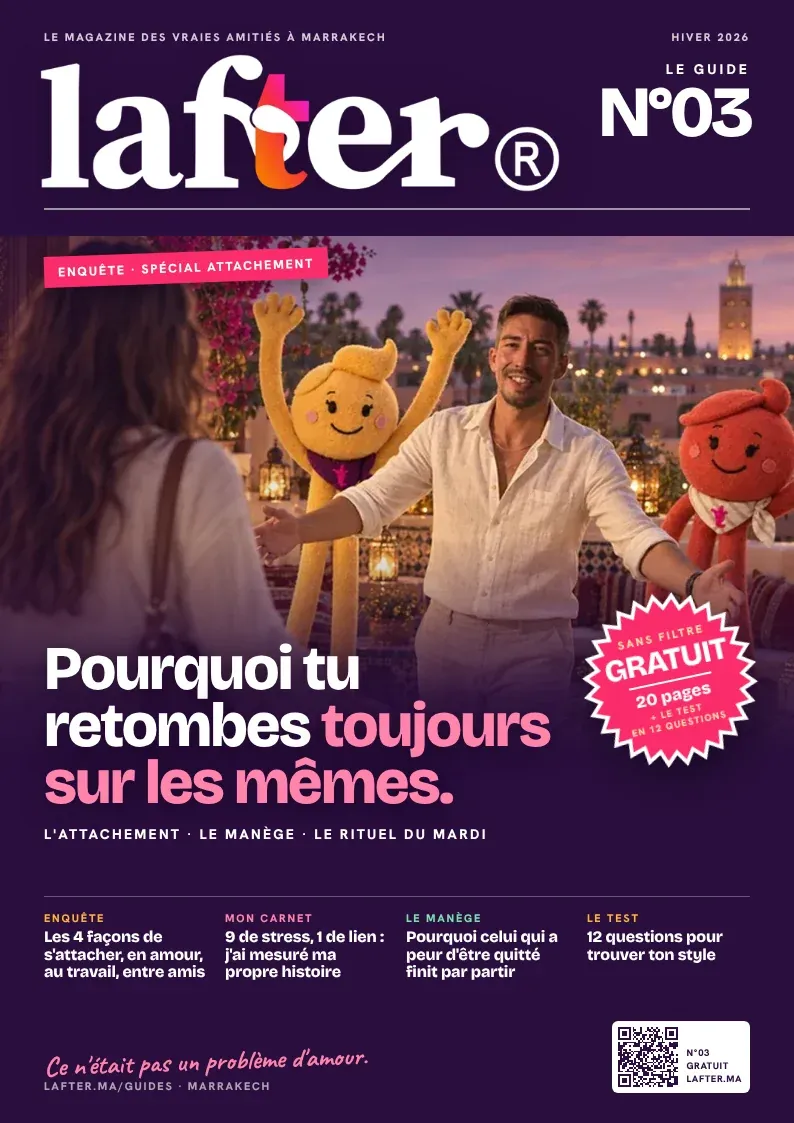
Your style isn't the same everywhere: you can be a rock at work and a bundle of nerves in love. And it shifts over time. Guide No. 03 offers a 90-second test, and the article why do I get attached so fast goes into the anxious profile and the gestures that help.
What to do, in 3 steps
- Think of someone who mattersNot the person you'd like to be: the real relationship, right now.
- Watch how you react to a silenceDo you write more, pull away, do both, or wait calmly?
- Compare with your other bondsYour boss, your mother, your best friend: the slider isn't always in the same place.
Frequently asked questions
Are online attachment style tests reliable?
Research questionnaires (ECR, ECR-R) give a reliable tendency when you answer honestly. None of them makes a diagnosis: the style varies with the relationship and the stage of life.
Is there data on attachment styles in Morocco?
No, there's no large survey of adult attachment styles in Morocco to date. International research shows that differences within a country are bigger than differences between countries.
What this text is based on
- Cindy Hazan and Phillip Shaver · Romantic love conceptualized as an attachment process, Journal of Personality and Social Psychology, 1987. Open the source
- Sheri Madigan et al. · The first 20,000 strange situation procedures: a meta-analytic review, Psychological Bulletin, 2023. Open the source
Spotted an error, or a source to add? Write to contact@lafter.ma: every correction is dated.
The long version
ArticleWhy do I get attached so fast (and how to slow down without closing up)Two coffees and you're already imagining the future? What research says about anxious attachment and the pursue-withdraw cycle, and simple gestures…Read →Words in this answer
Places mentioned
- Marrakech
- Morocco
How to cite this text
Prost, Jérémy (Jay). “What is an attachment style?”. Lafter questions, Lafter, Marrakech, updated 22 November 2026. lafter.ma/en/questions/what-is-an-attachment-style

I founded Lafter in Marrakech, a circle where you see the same faces every week. I write these texts like a reporter: a question that concerns me, the studies that answer it, and my own story when it helps. Every figure is sourced.
My story and the method →
Wherever you live in Marrakech, Tuesday 8pm.
The Lafter Coffee: a table composed by affinity, in a partner café. Free to discover, no commitment.
Save my seat