









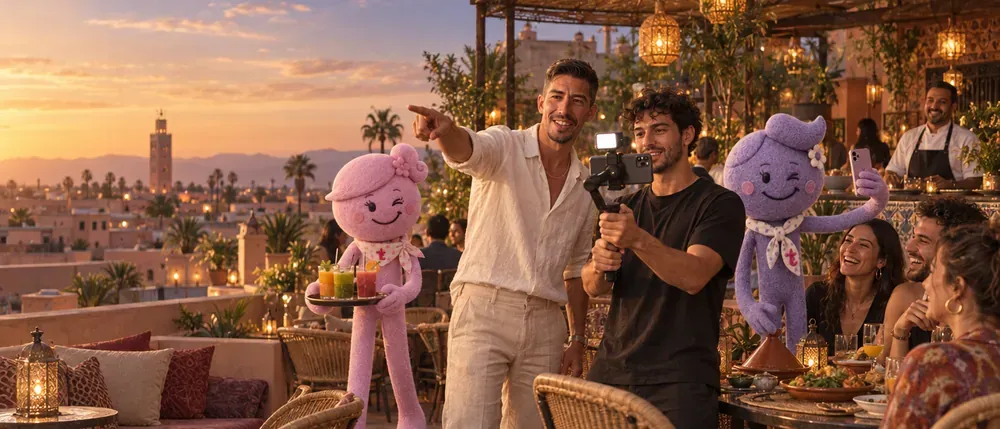

Are you in the circuit?
Tick without thinking. The verdict updates with every box.
This test doesn't judge anyone, neither you nor the other person. It measures one thing only: whether you're moving forward in your story with evidence, or with hopes.
The city where everyone flirts. And where no one gets attached.
Before talking about people, let's talk about the ground. Because in Marrakech, the night isn't neutral ground. Four forces shape it, and none of them is your fault.
- 1
The flow: a city that empties every week
Nearly 20 million visitors to Morocco in 2025, and a third of the country's overnight stays in Marrakech. Every week, thousands of people arrive with a return ticket. A story that starts on a Thursday has a good chance of being over by Sunday. On both sides.
- 2
The law: love outside marriage is outside the law
Article 490 of the penal code punishes relations outside marriage with one month to one year in prison. The result: love life hides, improvises in short-term rentals, and nobody introduces anybody. The blur protects those who lie.
- 3
The gap: one drink, half a day of minimum wage
The hourly minimum wage is 17.1 dirhams in 2025. Unemployment among 15 to 24-year-olds is above 37%. When your cocktail is worth four hours of minimum wage, your table is a possible workplace for someone. It isn't an insult, it's a fact.
- 4
The stage: everyone plays a role
Rooftops, filters, reserved tables, bottles that arrive with sparklers. Marrakech nightlife is a set designed so that everyone looks successful. A set says nothing about people. It says everything about what they want to show.
Four faces. Only one is worth waiting for.
In four years of nights out, I kept a notebook. Not out of cynicism: out of survival. From seeing the same scenes again and again, four profiles took shape. Not four types of people: four ways of occupying the night. The same person can switch between them depending on the month, the need, and you. They exist among women and men, among Moroccans and foreigners.
Method: personal observation by the founder, 2022 to 2026, in Marrakech's nightlife circuit. No personal data. The proportions below describe this circuit, not a city or a people.
- About 6 in 10 in the circuit
The stated price
The relationship has a price, and it's said early: “you want me, it's this much a night”, or its dressed-up version: the hotel, the bottle, the taxi, the rent. Frank, in the end. This profile isn't your enemy, it's the most honest of the four. It simply isn't a love story, and everyone at the table knows it, except sometimes you.
What it costs you: money. What it leaves you: a lesson.
- About 3 in 10 · the most costly
The zig-zag
A real job, a real life, real photos. And a selection: you, because you're new, alone, and you pay without counting. Feelings are the tool, not the goal. Here they say “zig-zag”: between work by day and the table at night, with occasional payment, a choice of the right tables, and a few months of play before being found out. The most dangerous form, because everything in it is half true.
What it costs you: months. And the trust that comes after.
- Across the board · all year
Passing through
The visitor who plays out the great one-week love story, and the resident who plays the romantic guide. Nobody is really lying: each tells themselves a story with a return ticket already booked. The problem isn't the week, it's when one of the two didn't know it was one.
What it costs you: nothing, if you know. Everything, if you didn't.
- About 1 in 10 · and they don't go out any more
The available ones
Whole people, who want a true story. Often they've already been through the first three faces, and are so put off that they've left the circuit: no more rooftops, no more stories, no more nights out. They're at work, with family, in a circle of friends. You won't meet them where you're looking. They're exactly where Lafter brings its own together.
What it costs you: time. What it gives you: the rest.
The places where a newcomer goes out at night aren't Marrakech. They're a shop window. Chapters 3 to 5 explain how to get out of it without leaving the city.
The 12 signals that never lie.
One alone means nothing. Three is a trend. Five, you have your answer, even if you don't want it.
- 1
The first name comes after “hbibi”. The sweet word before the person: you're a role, not someone.
- 2
Never a daytime plan. Coffee, market, walk: postponed. The nights, never.
- 3
The vague job. “In the night”, “in fashion”, “freelance”. No place, no hours, no colleague.
- 4
The broken phone, the late rent, the sick mother. Before the tenth time, it's a test. After, it's a habit.
- 5
The friends are all at the same three addresses. And none of them remembers your first name.
- 6
The bill always finds you. For the whole table. Even when you arrive last.
- 7
The stories tell of another week than the one in the messages.
- 8
Too fast. “I've never felt this” on day 9. Intensity is a technique before it's a proof.
- 9
You're gently isolated. “Your friends don't like me”, “go out with me instead”. Whoever isolates you has a reason.
- 10
Their place: never. Always yours, the hotel, a rental. And never any family, even from afar.
- 11
The visa, the trip, the marriage come up in conversation before the first Sunday together.
- 12
You hide the story from your own friends. When you have to lie to your own people, you already have your answer.
The daytime plan accepted the first time, and kept. Their friends invite you without them. You pay one time in two. The same story on the third and the tenth time. You're introduced to a cousin, a sister, a colleague, in the daytime.
And if you're from Marrakech?The signals are the same with a foreigner: the visa that comes up fast, the promise of elsewhere, the return ticket nobody mentioned. The circuit runs both ways.
Count, don't guessThe dashboard in the printable guide has you tick the signals as the weeks go by. One signal can be argued about. Five signals are a fact.
I'll call her “her”. It could just as well be “him”.
What I'm telling here happened to me. The details are changed, not the mechanism. I'm publishing it because everyone in Marrakech knows this story, and nobody writes it.
- Scene 1
The first bill
A rooftop, on a Thursday. She laughs at everything I say, and so do her friends. At the end, the bill lands in front of me, for six. I pay, flattered. She writes to me at 2am: “thanks for tonight, you're not like the others”. I keep that message. It cost me four months.
The signal I missed: No. 6, then No. 8.
- Scene 2
She had a job, that was true
She had a real position, hours, a badge. That's what reassured me. What I didn't see: the evenings she “went out with the girls” were the evenings another table paid. Day and night, in zig-zag. When I understood, it wasn't her who disappointed me most. It was me, for taking half a truth for the whole truth.
The signal I missed: No. 7, No. 5.
- Scene 3
The dinner where I understood
A year later, a table of eight people, all settled here for a long time. Each one had their version of my story: a man, two women, even a couple. And they had all done the same thing afterwards: stopped going out. They were there, those famous “good people”. They simply didn't go out in the circuit any more. That evening, Lafter was born.
The signal I finally saw: the fourth face.
Her, today? I don't hold it against her. She was playing the game this circuit offered her, with the cards she had. The question this guide asks isn't “who is to blame”. It's “where is the exit”.
You're not naive. You're recognisable.
A newcomer can be spotted a hundred metres away: they pay for the table, tell the story of their arrival, go back to the same bar, are alone on Sunday. And they arrive with the perfect mix: a little money, a lot of time, and a lack. Four mechanisms make you the ideal target. Knowing them is already a way out.
One French person in four feels lonely (Fondation de France, 2025), one person in six worldwide (WHO, 2025). On arriving in a city, everyone does. Lack makes you read interest where there's politeness, and love where there's a habit of the night.
2 · You confuse welcome and targetingMoroccan hospitality is real, generous, and asks for nothing. The circuit imitates it perfectly. The difference comes down to one question: does it continue when you stop paying?
3 · Graduates fall for it more oftenIn Monica Whitty's study of 11,780 adults, victims of romance scams are more often impulsive, trusting, and more highly educated than average. Not less intelligent: more sure of themselves. “It can't happen to me” is the first sentence of every story.
4 · Intensity makes you skip stepsA friendship takes 50 hours to become real (Hall, 2018). A story that claims to be real on the second night short-circuits exactly that time. Urgency is the tool of scammers all over the world: it stops you counting.
Marrakech is easy to love. Hard to live in.
A city that never sleeps is also a city where you no longer sleep. Here, Thursday is a Saturday and Sunday a Friday: you go out three times a week without realising it, at midnight, until four in the morning. The Marrakchis who are building a life get up early and don't go out on Tuesdays. This mismatch takes you away from exactly the people you're looking for. Then come the summer at forty-five degrees, Ramadan which reverses every rhythm, and the first-year wall, between the ninth and the fourteenth month, when many leave or shut themselves away.
The rule of thirds: for every night out, a daytime plan. For every new face, a face seen again. For every rooftop, a coffee at 8am. You'll keep Marrakech. And you'll keep yourself.
Why you always fall for the same people.
The circuit explains half the story. The other half is you: the way you attach, and sometimes the way you read people.
- ≈ 56%Secure
Comfortable with closeness and distance. They take their time, and can bear others taking theirs.
- ≈ 20%Anxious
Need signs, quickly and often. Get attached in a few days. The profile the circuit loves.
- ≈ 24%Avoidant
Close, then far. Hot, then cold. The zig-zag, without even meaning to, has all its gestures.
Distribution observed among adults by Hazan and Shaver (1987), the founding study that applied Bowlby's attachment theory to adult love. The proportions vary between studies; the order of magnitude doesn't.
The anxious + avoidant cycle. You arrive alone, so a little anxious, even if you usually aren't. You meet someone who blows hot and cold, by strategy or by nature. Every return of warmth seems like proof. Every chill makes you run. It's the oldest merry-go-round in the world, and the Marrakech circuit is its funfair. The way out isn't to change the other person: it's to recognise the ride, and get off.
If you're neurodivergent. ADHD, autism, giftedness: the implicit codes of the night (irony, vagueness, “we'll see”) are harder to read, and the intensity of beginnings hits harder. Recent studies show more intense rejection sensitivity and passion among adults with ADHD, and greater exposure to abuse in relationships among autistic adults. It isn't a weakness. It's a map. And a map can be read: that's the subject of guide No. 03.
Nobody looks for love at Lafter. That's why people sometimes find it there.
Lafter isn't an app for singles, and never will be. It's a friendship circle. But everything that breaks the circuit is found, by design, in a circle.
Two Lafter Coffees, then a members' vote with more than 85% in favour. A zig-zag doesn't last three Tuesdays in a row, at 8pm, over a coffee, with no bill to hand over. They don't come. Or they don't come back.
2 · DaylightThe Tuesday Coffee, the Sunday Connect, the Move sessions: dates where people see each other sober, rested, in the daytime or early in the evening. The set of the night isn't there. The people are.
3 · Time, the only weapon against the fakeSeeing the same faces every week is keeping an hour counter running. The fake doesn't last 50 hours. After ten times, you know who works where, who goes home how, and who is really free on Sunday.
4 · WitnessesIn a circle, you're no longer the only one watching. Almost every member has a notebook like mine. They see what you don't, and they tell you, because they have nothing to sell you.
And the stories that are born at Lafter? They happen. Not on the first Tuesday: on the twentieth. Between two people who have seen each other laugh, get things wrong, arrive late and come back anyway. In other words: between two people who already know each other. It's the only way we know of not getting taken in.
Book your Tuesday, 8pm.Free to discover. No commitment. Nobody will make you pay for the table.
Save my seatThe protocol of the 10 times.
Ten rules, for ten times. You don't judge anyone: you let time judge for you. What the circuit fears most isn't your mistrust. It's your patience.
- 1
Not a dirham before the tenth time
No phone, no rent, no ticket, no “little gift”. You pay your share, sometimes theirs, never the table.
- 2
The daytime plan before the night plan
Coffee at 10am, the market, a walk in the Agdal. Someone who can never see you in the daytime has a reason.
- 3
Their friends, your friends, within a month
Not “their friends from the table”. Their friends from life: colleagues, cousins, neighbours. And yours across from them.
- 4
Work has a place, hours, a colleague
No need to investigate. Someone who works talks about it unprompted, with details that don't change.
- 5
Slow down when it speeds up
“I've never felt this” on day 9 isn't a proof. It's the exact moment to slow down.
- 6
A witness
Someone who knows the city, whom you tell everything, and whom you listen to even when you don't like it.
- 7
Keep your circle
Never miss your Tuesday for a story. Whoever pulls you away from it does so for a reason.
- 8
The same story, ten times
True stories repeat themselves identically. False ones are rewritten every time.
- 9
You don't rescue anyone
“I'll get her out of there” is the circuit's favourite script. You're neither a charity nor an emergency exit.
- 10
If you lie to your friends, you have your answer
The day you hide a detail of the story from your own people, you already know what you are hiding.
0 times out of 10. Ten times at 2h30 is 25 hours: half of friendship's first threshold according to Hall.
The printable guide has a paper version of it, one per story.
The sentences that protect, without closing the door.
- “My phone is broken, can you help me?”I never mix money and feelings. Ever. But I'll be there on Tuesday.
- “Join me at 1am, we're all at the rooftop”Not tonight. Tea on Thursday at lunchtime?
- “I've never felt this, it's you”I like this beginning too. So let's see each other ten times, and talk about it again.
- “My friends don't like you, go out with me instead”Then come with mine on Sunday. They're curious to meet you.
- For yourself, on Sunday at 6pmWhat do I know about her or him that I didn't learn from their own mouth?
The rule: a short sentence, an open door, a daytime date. Everything else is a negotiation.
The Darija of the heart, and of limits
- Hbibi / Hbibti
- My darling. Quickly said, quickly given.
- Hayati
- “My life”. On day 3, it's a signal.
- Zwin / Zwina
- Handsome, beautiful
- Flouss
- Money. The word that changes everything.
- Sahbi / Sahbti
- My friend
- La, choukran
- No, thank you. Full stop.
- Safi
- That's enough, let's stop there.
- Hchouma
- Embarrassment. Useful on both sides.
- Bchwiya
- Gently. The word of the protocol.
- Nhar
- Day. As in “daytime plan”.
Tip: “bchwiya, bchwiya” said with a smile is the most useful phrase in this guide.

See them again before you love.
Ten times, in the daytime, with witnesses. The Tuesday Lafter Coffee, 8pm, is the simplest place to start counting. Free to discover, no commitment.
Save my seatFrequently asked questions
8 questions
Is it easy to find love in Marrakech?
It's easy to meet people here and hard to build something: many people are passing through, the law pushes unmarried couples into the shadows, and tourist nightlife is a circuit where some relationships are self-interested. Solid stories are born in the daytime, in circles, by seeing the same people again.
What is article 490 of the Moroccan penal code?
It punishes sexual relations between unmarried people with one month to one year in prison. Article 491 covers adultery, articles 497 to 503 prostitution. A reform of the penal code has been announced but had not been completed by October 2026.
Can an unmarried couple stay in a hotel in Morocco?
Foreign couples, yes. For Moroccan or mixed couples, a marriage certificate was often required; the Minister of Justice said in May 2024 that this requirement should end, but practice still varies from one establishment to another. Many use short-term rentals.
How do you recognise a self-interested relationship in Marrakech?
By the accumulation of signals, never by one alone: no daytime plans, a vague job, a request for money before the tenth time, friends you only see at the same addresses, a very fast intensity. The test and the 12 signals in this guide are there for that.
What does “zig-zag” mean in Marrakech?
It's the circuit's expression for someone who has a life and a job in the daytime, and who is occasionally paid at night, choosing their tables. The term is common in speech; we use it as it circulates, without turning it into a category of people.
Do apps for singles work in Marrakech?
They amplify the circuit: many profiles passing through, and the same mechanisms as elsewhere, only faster. They can be useful if you apply the 10-times protocol: daytime plans, friends on both sides, no money.
Why do I always end up with the same type of person?
Because the circuit selects profiles that resemble you, and because the way you attach (secure, anxious, avoidant) makes you read certain signals as proof. Chapter 4 gives the basics; guide No. 03 is devoted to it.
Is Lafter an app for singles?
No. Lafter is a private friendship circle in Marrakech, by co-optation, where you see the same faces every week. Stories are sometimes born there, on the twentieth Tuesday rather than the first. You join through the Lafter Coffee, free to discover.
What this text is based on
10 sources
- Moroccan Ministry of Tourism, 2025 review: 19.8 million arrivals (in French); Tourism Observatory, overnight stays in Marrakech, first ten months of 2025 (in French).
- Moroccan penal code, articles 490, 491 and 497 to 503 (in French); Courrier international, May 2024, on marriage certificates in hotels (in French).
- Bank Al-Maghrib, monetary policy report, March 2026 (in French): hourly minimum wage 17.1 DH in 2025.
- Haut-Commissariat au Plan, Activity, employment and unemployment, 2025 annual results (in French).
- Nabil Ayouch, Much Loved, 2015; The New York Times, 3 June 2015; The Guardian, 10 November 2015.
- Cindy Hazan and Phillip Shaver, “Romantic love conceptualized as an attachment process”, 1987.
- Jeffrey A. Hall, “How many hours does it take to make a friend?”, Journal of Social and Personal Relationships, 2018.
- Monica Whitty, “Do you love me? Psychological characteristics of romance scam victims”, Cyberpsychology, Behavior, and Social Networking, 2018.
- Fondation de France, Solitudes 2025 study; WHO, Commission on Social Connection, June 2025.
- O'Brien et al., Journal of Marital and Family Therapy, 2026 (ADHD and relationships); Griffiths et al., Vulnerability Experiences Quotient, 2019.
The four-faces barometer comes from the founder's personal notebook, kept from 2022 to 2026 in Marrakech's nightlife circuit: a testimony, not a statistic about the city or its people. The scenes in the notebook were lived, their details changed; no real person is named or identified. This guide is neither legal advice nor a diagnosis. If a relationship puts you in danger, talk to someone close to you, to your consulate or to a professional.
A mistake, a source to add? Write to contact@lafter.ma: every correction is dated.
Places mentioned
- Marrakech
- Agdal
To cite this text
Prost, Jérémy (Jay). “Loving in Marrakech without getting taken in”. The Lafter guides, No. 02, Lafter, Marrakech, updated 22 November 2026. lafter.ma/en/guides/loving-in-marrakech-without-getting-taken-in
I founded Lafter in Marrakech, a circle where you see the same faces every week. I write these texts like a report: a question that concerns me, the studies that answer it, and my own story, when it helps understanding. Every figure is sourced.
My background and the method →The guide as a PDF, right now.
The magazine edition, 20 pages, to keep, annotate and lend. The printed edition is in French for now; the tools are filled in with a pencil. Just tell us who we're giving it to.
Guide No. 02 is ready. Print it, annotate it, lend it.
Download the PDF (3.2 MB)