







Tu me connais vraiment ?Do you really know me?
Answer 5 questions about yourself. You get your felt Lafteez, with your first name. Send it to your friends: if they guess your answers, they really know you.
- No account
- Shared with one link

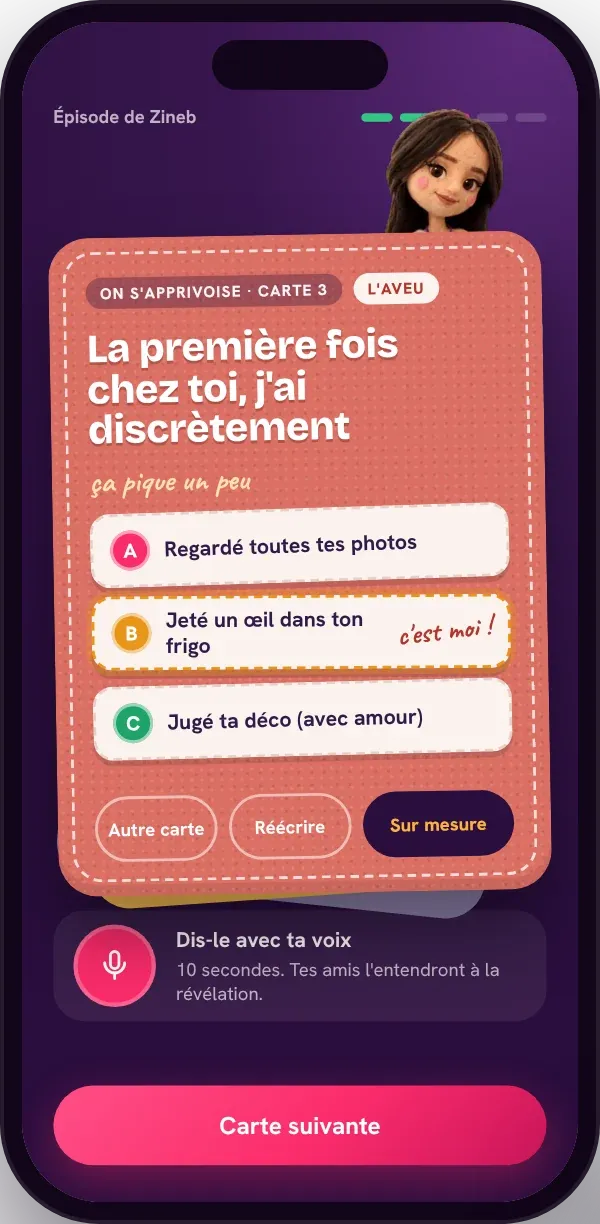
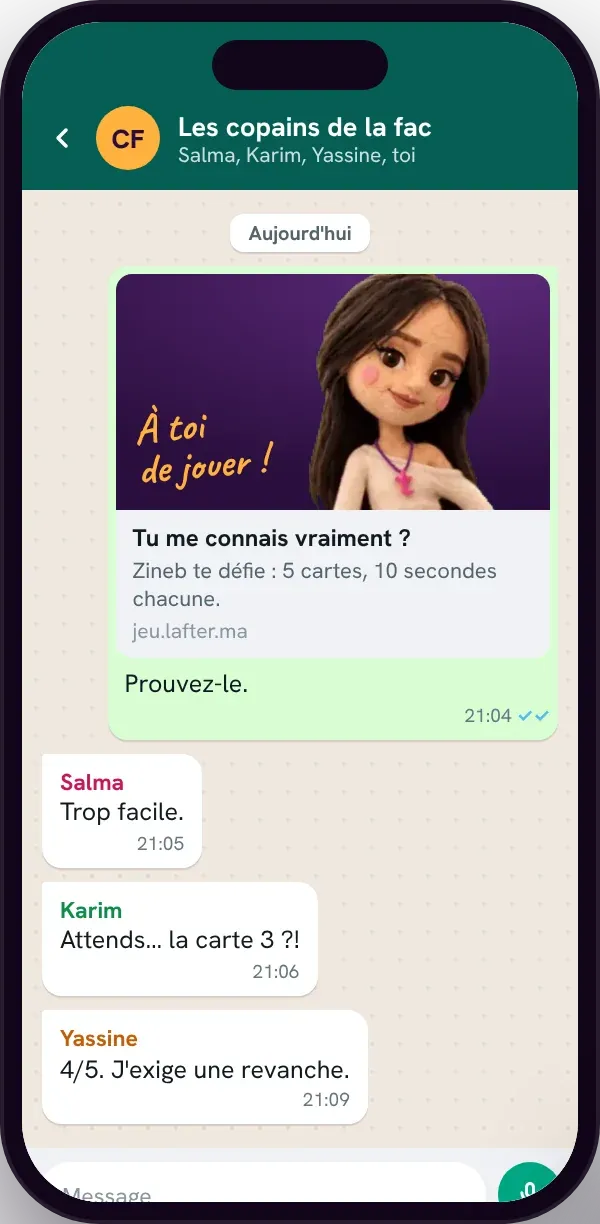
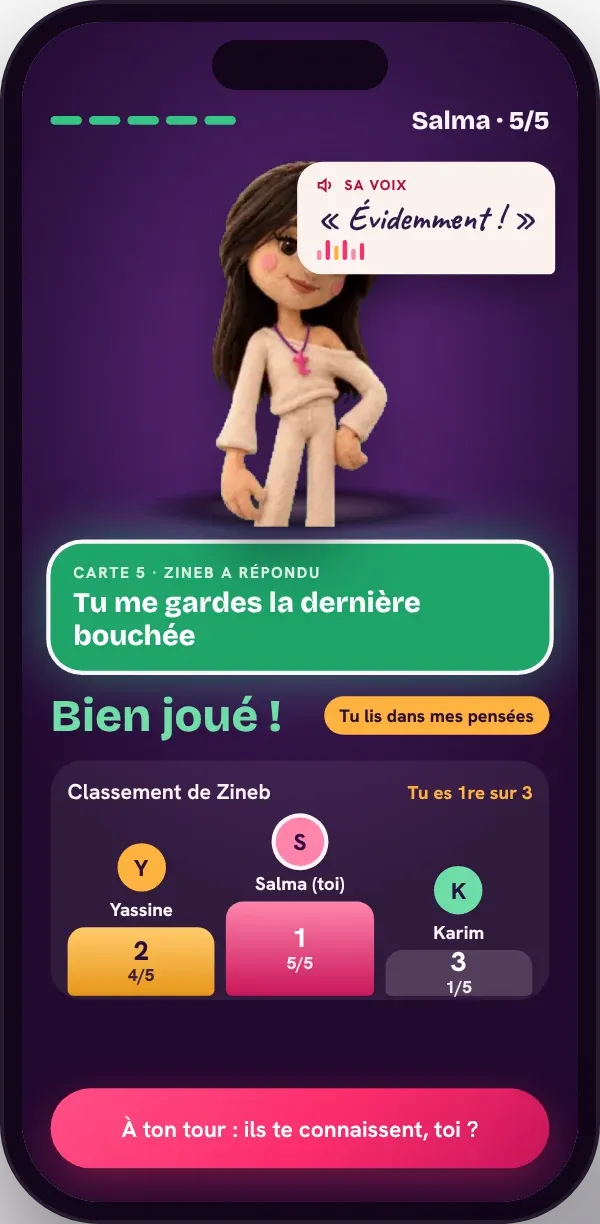
Zineb, a Lafteez, arrives, looks at the title, plays the game on her phone and invites you to play. She found 5 answers out of 5.
Free · no app · in French
You create. You send. They guess.
5 cards about you. Your friends have 10 seconds per card to find your answer.A game is 5 cards about you. Your friends have 10 seconds per card to find your answer. Those who really know you are revealed, the others demand a rematch.
Free · no app
Questions that make people say “how do you know that?!”
For your couple, your friends, your family or your colleagues. Choose a theme, tap a card to flip it. In the game, the cards are in French.Questions for your couple, your friends, your family or your colleagues, written by Lafter and designed for Marrakech. Every game follows an arc: we laugh, we hesitate, we confess, we look at ourselves, we melt. Choose a theme, flip a card. Shown here in English, played in French.
- The hook1 / 5easy… or not
The detail about you I noticed first
AYour smile, silly as it isBYour hands when you talkCYour shoes. I judge everything. Why does it work?Card 1 · The warm-upwe laughAn answer you think is easy. Those close to you overestimate what they know about you: the surer they are, the harder they fall.
Swann et Gill, 1997 Back to the card - The trap2 / 5don't rush
How long I took to answer your very first message
ATen seconds, zero strategyBTen minutes, to look coolCThe next day. I was nervous. Why does it work?Card 2 · The trapwe hesitateTwo almost identical answers. Married couples don't decode hints better than strangers, but they're much more sure of themselves.
Savitsky et al., 2011 Back to the card - The confession3 / 5this one stings
I've already sent a screenshot of our messages to
ANobody. Ever. Promise.BMy best friend foreverCThe whole group, analysis included Why does it work?Card 3 · The peakwe confessWe think we're transparent, we're not. The confession is the strongest moment of the game, and the card people screenshot.
Gilovich et al., 1998 Back to the card - The mirror4 / 5tell me if I'm wrong
What you noticed about me first (I think)
AMy laugh, a bit too loudBMy nerves, very visibleCMe being late, already Why does it work?Card 4 · The mirrorwe look at ourselvesWhat you think others think of you. We imagine we're less liked than we are: your friends will want to correct you.
Boothby et al., 2018 Back to the card - The tenderness5 / 5keep this one
The moment I knew I wanted to see you again
AAs soon as you arrivedBIn the middle of one of your storiesCThe next day, thinking it over Why does it work?Card 5 · The soft endingwe meltA declaration disguised as a question, three kind answers. We mostly remember the peak and the end: the game ends gently.
Kahneman et al., 1993 Back to the card
As a couple, the first weeks: first impressions, little calculations, nerves. Flip a card to see why it works.
- The hook1 / 5you'll get this one
Your name in my phone, right now
AYour first name, simple and effectiveBYour first name with an emojiCA nickname you don't know Why does it work?Card 1 · The warm-upwe laughAn answer you think is easy. Those close to you overestimate what they know about you: the surer they are, the harder they fall.
Swann et Gill, 1997 Back to the card - The trap2 / 5think carefully
When I answer “we'll see” to one of your ideas
AIt means yes, but laterBIt means no, politelyCI wasn't listening, sorry Why does it work?Card 2 · The trapwe hesitateTwo almost identical answers. Married couples don't decode hints better than strangers, but they're much more sure of themselves.
Savitsky et al., 2011 Back to the card - The confession3 / 5between us
The first time at your place, I discreetly
ALooked at all your photosBTook a peek in your fridgeCJudged your decor (with love) Why does it work?Card 3 · The peakwe confessWe think we're transparent, we're not. The confession is the strongest moment of the game, and the card people screenshot.
Gilovich et al., 1998 Back to the card - The mirror4 / 5seen from inside
What I think you thought of me at first
A“Nice, nothing more”B“Funny, but talks too much”C“Too good to be true” Why does it work?Card 4 · The mirrorwe look at ourselvesWhat you think others think of you. We imagine we're less liked than we are: your friends will want to correct you.
Boothby et al., 2018 Back to the card - The tenderness5 / 5I really mean it
The little thing you do that makes me melt
AYou remember silly detailsBYour “home safe?”CYou save me the last bite Why does it work?Card 5 · The soft endingwe meltA declaration disguised as a question, three kind answers. We mostly remember the peak and the end: the game ends gently.
Kahneman et al., 1993 Back to the card
As a couple, a few months in: the codes are born, and so is the first argument. Flip a card to see why it works.
- The reflex1 / 5see it coming?
My real reflex when your mother calls
AI pick up, in my best voiceBI hand you the phone, fastCI pick up and we talk for 40 min Why does it work?Card 1 · The warm-upwe laughAn answer you think is easy. Those close to you overestimate what they know about you: the surer they are, the harder they fall.
Swann et Gill, 1997 Back to the card - The trap2 / 5false lead guaranteed
When I say “safi, it's fine”, it means
AThat it's really sortedBThat it isn't sorted at allCThat I'm hungry. We'll talk later. Why does it work?Card 2 · The trapwe hesitateTwo almost identical answers. Married couples don't decode hints better than strangers, but they're much more sure of themselves.
Savitsky et al., 2011 Back to the card - The confession3 / 5I've never said this
My thing you dream of throwing out (and I'm keeping)
AAn old T-shirt with holesBCables that are no useCThe bag full of plastic bags Why does it work?Card 3 · The peakwe confessWe think we're transparent, we're not. The confession is the strongest moment of the game, and the card people screenshot.
Gilovich et al., 1998 Back to the card - The mirror4 / 5what I think I know
What your family says about me when I'm not there (I think)
A“You got lucky, you did”B“Late, but adorable”C“Give them more, they're hungry” Why does it work?Card 4 · The mirrorwe look at ourselvesWhat you think others think of you. We imagine we're less liked than we are: your friends will want to correct you.
Boothby et al., 2018 Back to the card - The tenderness5 / 5to screenshot
What still gets me about you today
AThe way you talk to my motherBYour laugh when you're tiredCYour off-key songs in the kitchen Why does it work?Card 5 · The soft endingwe meltA declaration disguised as a question, three kind answers. We mostly remember the peak and the end: the game ends gently.
Kahneman et al., 1993 Back to the card
As a couple, a year and more: rituals, habits, in-laws. Flip a card to see why it works.
- The hook1 / 5easy… or not
Which of us sent the first message?
AHimBHerCA mutual friend, actually Why does it work?Card 1 · The warm-upwe laughAn answer you think is easy. Those close to you overestimate what they know about you: the surer they are, the harder they fall.
Swann et Gill, 1997 Back to the card - The trap2 / 5don't rush
Which of us says “on my way” still in pyjamas?
AHimBHerCBoth. It's our secret. Why does it work?Card 2 · The trapwe hesitateTwo almost identical answers. Married couples don't decode hints better than strangers, but they're much more sure of themselves.
Savitsky et al., 2011 Back to the card - The confession3 / 5between us
The nickname we call each other when nobody is listening
AA sweet word in DarijaBThe name of a pastryCA ridiculous animal name Why does it work?Card 3 · The peakwe confessWe think we're transparent, we're not. The confession is the strongest moment of the game, and the card people screenshot.
Gilovich et al., 1998 Back to the card - The mirror4 / 5seen from inside
Which of us has changed the other more?
AHimBHerCNeither, we resist Why does it work?Card 4 · The mirrorwe look at ourselvesWhat you think others think of you. We imagine we're less liked than we are: your friends will want to correct you.
Boothby et al., 2018 Back to the card - The tenderness5 / 5keep this one
The moment we both knew
AFrom the very first eveningBOn a first tripCOn a tough day, together Why does it work?Card 5 · The soft endingwe meltA declaration disguised as a question, three kind answers. We mostly remember the peak and the end: the game ends gently.
Kahneman et al., 1993 Back to the card
The couple answers with one voice, the people close to them guess. Flip a card to see why it works.
- The hook1 / 5to warm up
In the WhatsApp group, I am
AThe one who revives the plansBThe one who reads without answeringCThe king or queen of voice notes Why does it work?Card 1 · The warm-upwe laughAn answer you think is easy. Those close to you overestimate what they know about you: the surer they are, the harder they fall.
Swann et Gill, 1997 Back to the card - The trap2 / 5think carefully
When I say “inchallah” to a plan, it means
AYes, I'm coming, promiseBNo, but politelyCYes, if someone picks me up Why does it work?Card 2 · The trapwe hesitateTwo almost identical answers. Married couples don't decode hints better than strangers, but they're much more sure of themselves.
Savitsky et al., 2011 Back to the card - The confession3 / 5this one stings
The message I typed then deleted in the group
AAn “I miss you all”BMy opinion on a new coupleCA joke, too risky Why does it work?Card 3 · The peakwe confessWe think we're transparent, we're not. The confession is the strongest moment of the game, and the card people screenshot.
Gilovich et al., 1998 Back to the card - The mirror4 / 5tell me if I'm wrong
What you say about me when I'm not there (I think)
A“Late, but we love them”B“You have to call them three times”C“Without them, it's flat” Why does it work?Card 4 · The mirrorwe look at ourselvesWhat you think others think of you. We imagine we're less liked than we are: your friends will want to correct you.
Boothby et al., 2018 Back to the card - The tenderness5 / 5I really mean it
What I never tell you (but I think it)
AYou're my second familyBWithout you, Marrakech would be dullCI keep all our photos Why does it work?Card 5 · The soft endingwe meltA declaration disguised as a question, three kind answers. We mostly remember the peak and the end: the game ends gently.
Kahneman et al., 1993 Back to the card
You answer, your friends guess. The WhatsApp group is the playground. Flip a card to see why it works.
- The hook1 / 5easy… or not
My mother's sentence I repeat despite myself
A“Put a jacket on”B“Have you eaten?”C“This isn't a hotel” Why does it work?Card 1 · The warm-upwe laughAn answer you think is easy. Those close to you overestimate what they know about you: the surer they are, the harder they fall.
Swann et Gill, 1997 Back to the card - The trap2 / 5don't rush
The auntie's question I dread most
A“So when's the wedding?”B“Where do you work again?”C“You don't come to see us any more?” Why does it work?Card 2 · The trapwe hesitateTwo almost identical answers. Married couples don't decode hints better than strangers, but they're much more sure of themselves.
Savitsky et al., 2011 Back to the card - The confession3 / 5between us
What I do to get out of the washing-up
AI offer to serve the teaBI play with the little cousinsCA fake call, very important Why does it work?Card 3 · The peakwe confessWe think we're transparent, we're not. The confession is the strongest moment of the game, and the card people screenshot.
Gilovich et al., 1998 Back to the card - The mirror4 / 5seen from inside
What the family says about me when I'm not there
A“Always on the phone”B“Always late”C“Heart of gold” Why does it work?Card 4 · The mirrorwe look at ourselvesWhat you think others think of you. We imagine we're less liked than we are: your friends will want to correct you.
Boothby et al., 2018 Back to the card - The thank-you5 / 5I rarely say it
What I've never told my parents
AThank you for all those sacrificesBYou were right, oftenCI'm proud of you Why does it work?Card 5 · The soft endingwe meltA declaration disguised as a question, three kind answers. We mostly remember the peak and the end: the game ends gently.
Kahneman et al., 1993 Back to the card
Brothers, sisters, cousins, parents, and the auntie who always asks the same question. Flip a card to see why it works.
- The hook1 / 5you'll get this one
The sentence I say most in meetings
A“Shall we set up a catch-up?”B“Just to bounce off that…”C“Can you hear me now?” Why does it work?Card 1 · The warm-upwe laughAn answer you think is easy. Those close to you overestimate what they know about you: the surer they are, the harder they fall.
Swann et Gill, 1997 Back to the card - The trap2 / 5false lead guaranteed
My emoji for saying “no” politely
AThe thumbs upBThe joined handsCThe tense smile Why does it work?Card 2 · The trapwe hesitateTwo almost identical answers. Married couples don't decode hints better than strangers, but they're much more sure of themselves.
Savitsky et al., 2011 Back to the card - The confession3 / 5this one stings
What I do on video calls, camera off
AI take notes, honestlyBI answer other messagesCI have lunch, discreetly Why does it work?Card 3 · The peakwe confessWe think we're transparent, we're not. The confession is the strongest moment of the game, and the card people screenshot.
Gilovich et al., 1998 Back to the card - The mirror4 / 5what I think I know
What you say about me at the coffee machine (I think)
A“Always in a good mood”B“Answers emails at 11pm”C“Best snacks in the office” Why does it work?Card 4 · The mirrorwe look at ourselvesWhat you think others think of you. We imagine we're less liked than we are: your friends will want to correct you.
Boothby et al., 2018 Back to the card - The thank-you5 / 5for once
What really makes me like coming here
AYou. Yes, it's corny.BThe 4pm gigglesCThe coffee. And a bit of you. Why does it work?Card 5 · The soft endingwe meltA declaration disguised as a question, three kind answers. We mostly remember the peak and the end: the game ends gently.
Kahneman et al., 1993 Back to the card
Office, open space, video calls: nothing awkward, everything funny. Flip a card to see why it works.
- The hook1 / 5to warm up
The number of outfits I'll wear on the day
AJust one, simple and beautifulBThree, that's reasonableCAs many as the neggafa wants Why does it work?Card 1 · The warm-upwe laughAn answer you think is easy. Those close to you overestimate what they know about you: the surer they are, the harder they fall.
Swann et Gill, 1997 Back to the card - The trap2 / 5don't rush
The person who will cry first
AMy mother, before it even startsBMy father, in secretCMe, from the entrance Why does it work?Card 2 · The trapwe hesitateTwo almost identical answers. Married couples don't decode hints better than strangers, but they're much more sure of themselves.
Savitsky et al., 2011 Back to the card - The confession3 / 5this one stings
My state of mind when they carry me on the amaria
AI'll wave like a starBI'll hold on very tightCI'll close my eyes until the end Why does it work?Card 3 · The peakwe confessWe think we're transparent, we're not. The confession is the strongest moment of the game, and the card people screenshot.
Gilovich et al., 1998 Back to the card - The mirror4 / 5tell me if I'm wrong
What my in-laws already call me
AMy first name, with respectBA sweet little nicknameCNothing yet. They're watching me. Why does it work?Card 4 · The mirrorwe look at ourselvesWhat you think others think of you. We imagine we're less liked than we are: your friends will want to correct you.
Boothby et al., 2018 Back to the card - The tenderness5 / 5to screenshot
What made me say “it's him” or “it's her”
AThe way they talk to my motherBTheir laugh, impossible to forgetCOn a tough day, they were there Why does it work?Card 5 · The soft endingwe meltA declaration disguised as a question, three kind answers. We mostly remember the peak and the end: the game ends gently.
Kahneman et al., 1993 Back to the card
Before the big day, the guests guess: neggafa, amaria, dakka marrakchia. Flip a card to see why it works.
Yours, made to measure.
Type a true fact about yourself. Lafter turns it into a card, with the trap and the answer that makes people laugh. Nobody saw it coming, and it's the one people screenshot.
What I really think of surprise birthday parties
AI hate them. Don't even try.that's me!BI love them, especially when they're for meCIt all depends on the size of the cake- 142cards written by Lafter, designed for Marrakech
- 8themes, from the first date to the wedding
- 10 sto answer, on instinct
- 0apps for your friends to install
Your Lafteez, felted in your image.
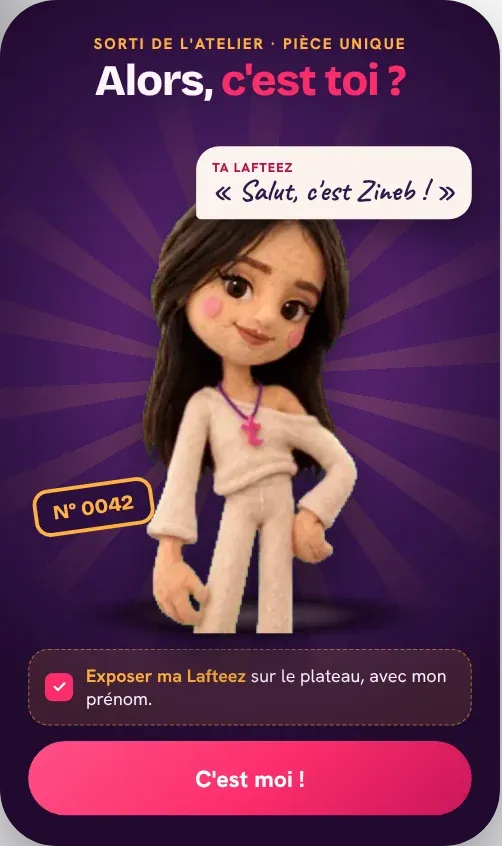
One selfie, and the workshop gets to work. The ring of wool rises, the felt follows, and your Lafteez appears: with your first name, numbered, unique. She plays your part in all your games.

- We read your face
- We choose the wool
- We felt your hair
- We embroider your smile
Your Lafteez joins all of Marrakech, on one board.
Tick “show my Lafteez”: every Wednesday at 10am, the new Lafteez arrive on the board, with their first name. Scroll, tap a Lafteez to discover it.A rooftop at sunset, which grows with every arrival. Click a Lafteez to discover it.
Lafteez made from a photo are in front, mascots behind, on the low wall. Gold label for distinctions, crown for special guests. Updated every Wednesday.
Who knows you best?
At the end, the best spy gets a card to share. One story, and their friends want theirs.
The game “Tu me connais vraiment ?”, in 8 questions.
Is the game “Tu me connais vraiment ?” free?
Yes, entirely. Your friends play from their phone, with no app and no account: a link is enough.
What language is the game in?
The game is in French for now, like the circle it was born in. The cards are short and the answers are multiple choice, so it also works with friends who are learning French.
How does a game work?
You choose a theme and answer 5 cards about yourself. You send your link on WhatsApp. Each friend has 10 seconds per card to guess your answer, then sees their score out of 5 and the ranking.
Which themes can you choose?
As a couple (getting to know each other, getting used to each other, settled couple), the two of you, among friends, with family, with colleagues and for newlyweds. 142 cards in all, written by Lafter. You can also create a custom card from a true fact about yourself.
What happens to my photo?
It is only used to felt your Lafteez, and it is deleted as soon as the wool is in place. Your Lafteez stays yours: you can delete it at any time from your space.
Why does Lafter ask for my WhatsApp number?
It creates your board pass, with your number in order of arrival, and lets you find your Lafteez again. Lafter only writes to you if you agree. The pass is for people aged 18 and over.
Does my Lafteez appear on the board?
Only if you tick “show my Lafteez”. Lafter approves it, and it arrives on the board the following Wednesday at 10am, with your first name.
How long does a game last?
Your link stays open for 30 days, then the game is deleted. Your Lafteez stays.

Your Lafteez is on the board. Where are you on Tuesday?
The circle's Lafteez meet every Tuesday at 8pm over a Lafter Coffee in Marrakech. Your first two are free.
Save my seatTuesday 24 November, 8pm · Marrakech