










To go out at night in Marrakech without falling into the circuit, keep the night for pleasure but don't hand it your social life: plan a daytime plan for every night out, see the same faces again, and don't mix money and feelings before the tenth time. The circuit is a handful of addresses where many people are passing through.
Why does going out at night in Marrakech feel like going round in circles?
Because you're not going out in Marrakech: you're going out in a circuit. A few addresses, always the same, where the night is a set and many people are just passing through. You can go out there three times a week for a year without building anything.
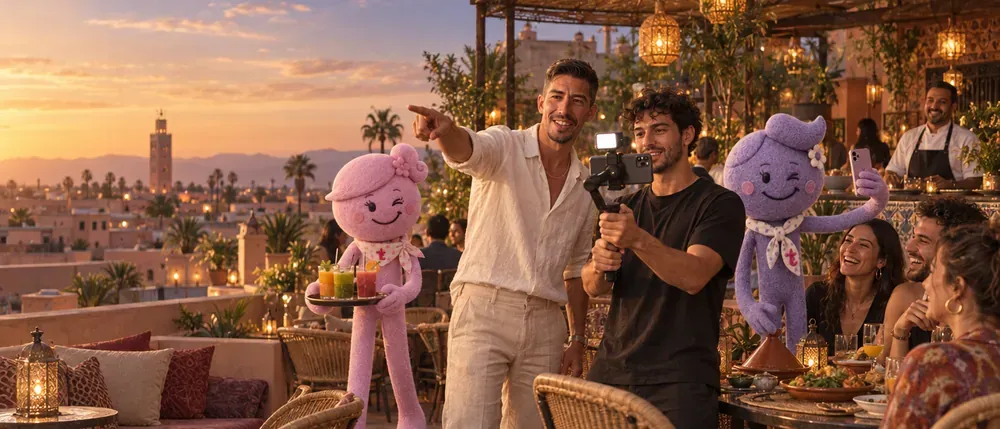
You know the scene. Thursday, 11pm, a rooftop in the Medina, the Koutoubia lit up in the distance. You've been seated at a table of six, you know one person. Someone calls you “hbibi” before they've learned your first name. The laughter comes easily, the music rises, a bottle arrives. At the end, the bill lands in front of you. For the whole table.
The next day, you suggest a 10am coffee to the person you talked to most. Not this morning. Not tomorrow either. But on Saturday everyone will be in Hivernage, are you coming? You say yes. And the week starts again.
This text puts no one on trial. Not the city, not Marrakchis, not those who love going out. The problem is a circuit, and a circuit can be understood, spotted and left without leaving Marrakech.
What is the Marrakech night circuit?
The circuit is Marrakech's tourist night: a small network of addresses where visitors and newcomers go out, and where some relationships are about money. It isn't the city, it's its shop window. Guide No. 02, “Loving in Marrakech without getting taken in”, describes it in detail; here's the essence.
Four forces shape it, and none of them is your fault. The flow, first: 19.8 million visitors to Morocco in 2025 according to the Ministry of Tourism, and a third of the country's overnight stays recorded in Marrakech. A story that starts on a Thursday has a good chance of being over by Sunday. On both sides.
The law, next: article 490 of the penal code punishes sex outside marriage with one month to one year in prison. Love lives are hidden, nobody introduces anyone, and the blur protects those who lie.
The gap, too: according to Bank Al-Maghrib, the hourly minimum wage was 17.1 dirhams in 2025. When a rooftop cocktail is worth several hours of minimum wage, your table can become a workplace for someone. It isn't an insult, it's a fact.
The set, finally: reserved tables, filters, bottles arriving with sparklers. A setting designed so that everyone looks like they've made it. It says nothing about the people. It says everything about what they want to show.
Hivernage, Guéliz, Medina, Palmeraie, Agafay: where does the circuit run?
The circuit runs through precise places, but no neighbourhood comes down to it: everywhere you also meet people who live here and simply go out to dinner with friends.
Hivernage is its heart: clubs, hotels, reserved tables, a night that starts at midnight and ends at four. Guéliz is its resident version, with bars and restaurants where you often see the same faces. It's reassuring, and misleading: you think you know people you've never seen in broad daylight.
The Medina rooftops offer the finest view of the city and the strongest staging. The Palmeraie and the Agafay Desert, less than an hour's drive away, add villas, dinners under tents and nights under the stars. Magnificent, and often designed for groups who leave on Sunday.
And Jemaa el-Fna? It's almost the opposite. In the evening the square belongs to families, musicians, the smoke from the grill stalls, Marrakchis and visitors strolling. Nobody reserves a table there, nobody plays at success. It's a reminder of something simple: the Marrakech night isn't the circuit. The circuit is only a small part of it, the most visible to a newcomer.
The signals that show you're in the circuit
One signal means nothing. Three make a trend. Five, you have your answer, even if you don't want it. Here are the ones that come up most, taken from the guide's twelve signals.
Never a daytime plan: the coffee, the market, the Saturday-morning walk are always postponed; the nights, never. The bill always finds you, for the whole table, even when you arrive last. The job is vague: “in the night business”, “in fashion”, “freelance”, with no place, no hours, no colleague.
Their friends are all at the same three addresses, and none of them remembers your first name. It goes too fast: “I've never felt this before” on day nine. And a request for money comes before the tenth time: a broken phone, late rent, a sick mother.
The opposite signals count just as much: a daytime plan accepted straight away and kept, friends who invite you without him or her, a bill split one time in two, the same story the third and the tenth time. To go further, read how to tell if someone is interested in you for money.
And if you're a Marrakchi? The signals are the same with a foreign partner: the visa that comes up quickly in conversation, the promise of elsewhere, the return ticket you hadn't been told about. The circuit runs both ways.
Why newcomers fall into the circuit more often
Because a newcomer can be spotted from afar: they pay for the table, they tell the story of their arrival, they go back to the same bar, they're alone on Sundays. You're not naive. You're recognisable.
Loneliness skews the reading. Arriving in a city means being alone for a while, and that lack makes you read interest where there's politeness. Welcome and targeting look alike: Moroccan hospitality is real, generous, and asks for nothing. The circuit imitates it very well. The difference comes down to one question: does it continue when you stop paying?
Intensity skips the steps. According to researcher Jeffrey Hall (University of Kansas, 2018), it takes about 50 hours together to become casual friends. A story that already calls itself immense on the second night short-circuits exactly that time. If you recognise yourself in this need to go fast, read why do I get attached so fast: the way you get attached explains the other half of the story.
How to go out differently in Marrakech, starting this week
You don't need to stop going out. You need to rebalance: keep the night for pleasure, and entrust your bonds to the daytime and to repetition.
The rule of thirds. For every night out, a daytime plan. For every new face, a face seen again. For every rooftop, an 8am coffee. It isn't a punishment, it's a balance: you keep Marrakech, and you keep yourself.
Concrete daytime plans. A 10am coffee in Guéliz, a Saturday-morning walk in Agdal, the Majorelle Garden at opening time before the crowds, the souks in the morning when the craftsmen raise their shutters. Suggest them to the people who interest you. The one who can never see you in the daytime has a reason.
The 10 times protocol. Before getting attached, see the person ten times, in daytime, with witnesses, without money: not a dirham before the tenth time, their friends and yours within a month, the same story every time. The 10 times protocol judges no one: it lets time judge for you.
Settings you come back to. A sports club, a weekly workshop, a circle of friends. The test is simple: will I see these people again next week? That's where the people you're looking for are, often out of the circuit after passing through it. And remember one word of Darija, “bchwiya”: gently. Said with a smile, it's the most useful sentence of the night.
Lafter: a fixed date, far from the set
Lafter isn't an app for singles and never will be. It's a private friendship circle in Marrakech, where you see the same faces every week. But everything that breaks the circuit is found there, by design.
The way in is the Lafter Coffee, on Tuesdays at 8pm at the moment: 1h30 in a partner café, a table composed by affinity, a host and a ritual that gets past small talk. Your first two Lafter Coffees are free, your drinks are on you. Nobody will make you pay for the table.
After two Lafter Coffees, the members vote on your entry: you need more than 85% yes. A setting that asks you to come back, sober, at a fixed time, naturally discourages those who were only after a bill. And the members see what you don't, because they have nothing to sell you.
Stories born at Lafter? They sometimes happen. Not on the first Tuesday: on the twentieth, between two people who already know each other. If you want to start counting, apply.
Key takeaways
- 1The circuit is Marrakech's tourist night: a few addresses where many people are passing through and where some relationships are about money.
- 2The problem is neither the city nor Marrakchis: it's a circuit, spotted through concrete signals such as no daytime plans, a bill that always comes back to the same person and an intensity that's too fast.
- 3The rule of thirds helps you go out differently: for every night out, a daytime plan, and for every new face, a face seen again.
- 4The 10 times protocol means seeing a person ten times, in daytime, with witnesses and without money, before getting attached.
- 5In Morocco, article 490 of the penal code punishes sex outside marriage with one month to one year in prison, which pushes couples into the shadows.
Frequently asked questions
Where can you go out at night in Marrakech when you live here?
Keep the addresses you like, in Guéliz or Hivernage, but balance them with regular dates where you see the same people: a sports club, a workshop, a circle like Lafter on Tuesday evenings. That's where nights out become bonds.
Should you avoid the rooftops of Marrakech?
No. The view is magnificent and many people simply have a good time there. The trap isn't the place, it's making it the only place where you build your social life.
Is Jemaa el-Fna part of the night circuit?
Not really. In the evening the square is above all a popular space, with families, musicians and grill stalls. The circuit is more in the clubs, the reserved tables and some rooftops.
How can you tell whether someone met at night in Marrakech is serious?
Suggest a daytime plan and watch. An available person quickly accepts a 10am coffee, introduces you to their friends and doesn't ask you for money. Count the signals rather than guessing.
What this text is based on
- allAfrica / Daba Finance · Tourism in Morocco reaches 19.8 million visitors in 2025, according to the Ministry of Tourism (January 2026, in French). Open the source
- Bladi.net · Marrakech, a third of Morocco's overnight stays, according to the Tourism Observatory (first ten months of 2025, January 2026, in French). Open the source
- Moroccan Penal Code, consolidated version of 5 July 2018, article 490 (in French). Open the source
- Bank Al-Maghrib · Monetary policy report, March 2026 (2025 hourly minimum wage, in French). Open the source
- KU News · Study reveals number of hours it takes to make a friend (University of Kansas, Jeffrey Hall, March 2018). Open the source
Spotted an error, or a source to add? Write to contact@lafter.ma: every correction is dated.
Words in this article
Places mentioned
- Marrakech
- Morocco
- Medina
- Koutoubia
- Hivernage
- Guéliz
- Palmeraie
- Agafay Desert
- Jemaa el-Fna
- Agdal
- Majorelle Garden
- souks
How to cite this text
Prost, Jérémy (Jay). “Going out at night in Marrakech without falling into the circuit”. The Lafter magazine, Lafter, Marrakech, published 22 November 2026. lafter.ma/en/blog/going-out-in-marrakech-without-falling-into-the-circuit
I founded Lafter in Marrakech, a circle where you see the same faces every week. I write these texts like a reporter: a question that concerns me, the studies that answer it, and my own story when it helps. Every figure is sourced.
My story and the method →
Wherever you live in Marrakech, Tuesday 8pm.
The Lafter Coffee: a table composed by affinity, in a partner café. Free to discover, no commitment.
Save my seat